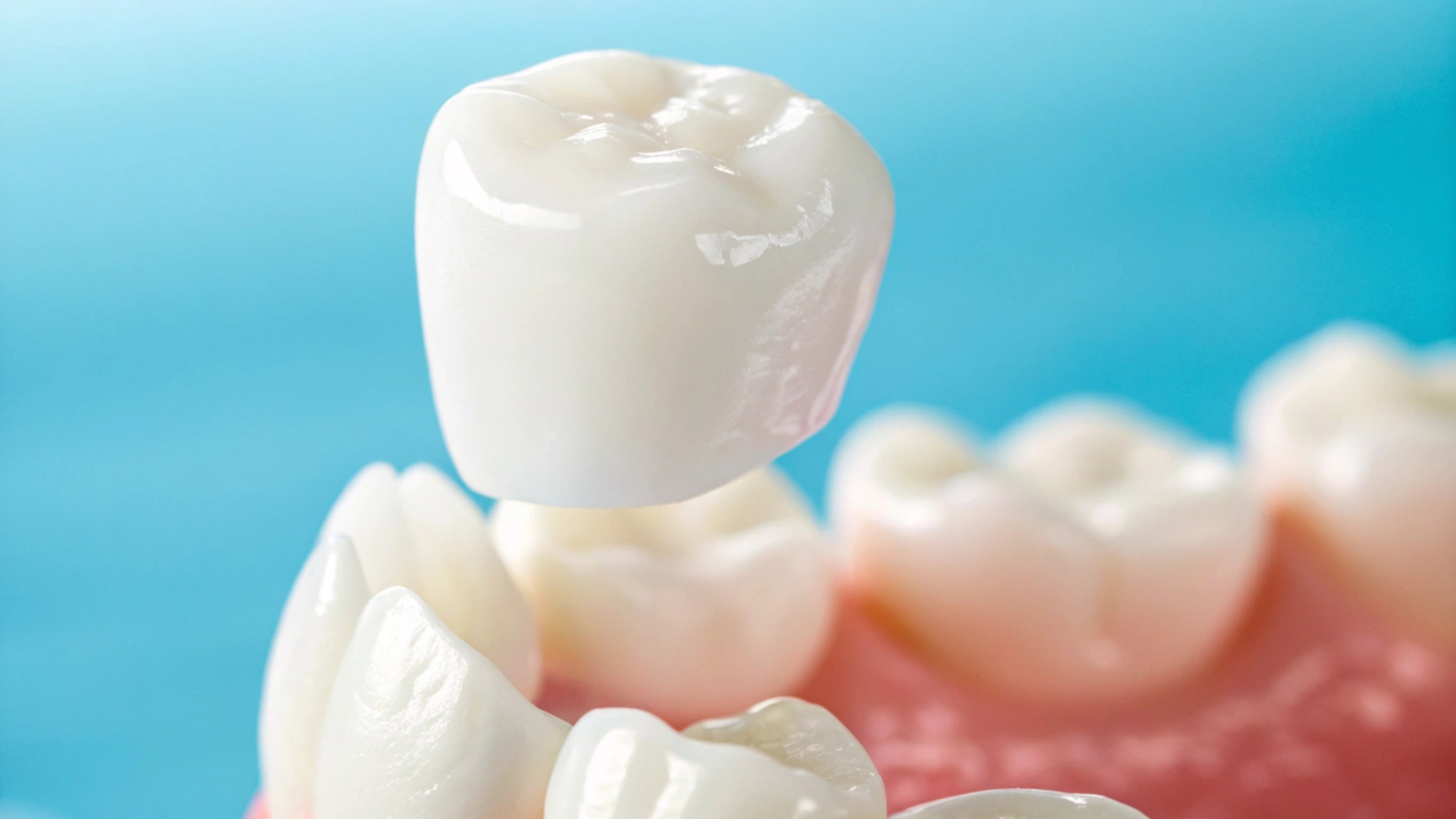
A crown covers a tooth completely, rebuilding its shape and taking the chewing load the tooth can no longer carry on its own. It is what dentists reach for once a tooth has cracked, lost a wall, or been hollowed out by a large filling.
It is also one of the more expensive things you are likely to be quoted for, which makes the useful question a slightly different one. Not what a crown is, but whether the particular tooth in front of you genuinely needs one yet.
Plenty of teeth do, and leaving those alone tends to end badly. Others sit closer to the line and get crowned earlier than they needed to be.
Do you actually need a crown?
Crowns sit on a ladder of options, and each rung suits a different amount of remaining tooth. Move up too early and you waste healthy structure. Move up too late and you risk losing the tooth.
Option | When it is the right call | What it leaves behind |
A large filling | Decay is contained and the walls of the tooth are sound | Most of the natural tooth |
Inlay or onlay | The cavity is wide but the outer walls still stand | More tooth than a crown removes |
Crown | Walls are thin, cracked, or the tooth has been root treated | The core of the tooth, capped and protected |
Extraction | The tooth is split below the gum or cannot be restored | A gap needing an implant or bridge |
The signals that genuinely warrant a crown are specific ones. A cracked cusp, a tooth that has lost a wall, a filling occupying most of the biting surface, a tooth that flexes and aches when you release a bite, or a back tooth that has had root canal treatment.
What does not by itself justify a crown is a filling that is simply old, or a tooth that looks slightly worn but functions perfectly well. If we recommend a crown, ask us what specifically changes if you wait, and you should get a straight answer.
What a crown does that a filling cannot
A filling sits inside a tooth and relies on the surrounding walls to hold it. A crown covers the tooth and takes the chewing load itself, which is the structural difference.
Once a tooth has lost enough of its walls, a larger filling becomes counterproductive. The remaining rim of tooth ends up thin, and thin walls flex under load and eventually crack, sometimes below the gum where the tooth cannot be saved.
A crown wraps that weakened structure and distributes force across the whole tooth instead of into a vulnerable wall. It is the difference between filling a hole and binding something together.
Which crown material suits the tooth
Material choice depends on where the tooth sits, how hard you bite, and how much the appearance matters.
Material | Appearance | Strength | Typically used for |
Zirconia | Good, slightly more opaque | Very high | Back teeth, heavy grinders |
Layered porcelain | Excellent, highly lifelike | Moderate to high | Front teeth, visible areas |
Porcelain fused to metal | Good, can show a dark line at the gum over time | High | Older technique, still used in some cases |
Gold alloy | Metallic | Very high | Back molars where appearance matters little |
Zirconia
Zirconia is a ceramic with exceptional strength, and it has become the common choice for back teeth. It resists fracture well under heavy chewing and grinding, and it can be made in thinner sections than older ceramics, which means slightly less tooth needs removing.
Its appearance is good rather than outstanding. Modern zirconia is considerably more lifelike than early versions, though a layered porcelain crown usually still looks better on a front tooth.
Layered porcelain
Porcelain crowns, including lithium disilicate, offer the most natural appearance because the material handles light much the way enamel does. That translucency is what stops a crown looking flat next to real teeth.
They are strong enough for most situations but less forgiving than zirconia under heavy grinding, so where you clench hard the material choice gets weighed differently.
Porcelain fused to metal
An older approach with a metal substructure under a porcelain surface. It is durable and still appropriate in some cases, though the metal margin can become visible as a dark line if the gum recedes over the years.
Gold alloy
Rarely requested now, but worth mentioning because it performs extremely well. Gold is kind to the opposing teeth, seals reliably and lasts a very long time. Appearance is the only real reason it fell out of favour.
Same-day crowns or laboratory crowns?
Both approaches produce a good crown. They differ in timing, in how the crown is manufactured, and in what each one suits.
| Same-day crown | Laboratory crown |
Visits | One | Usually two |
Temporary crown | Not needed | Worn for two to three weeks |
Made by | Milled in the practice from a digital scan | Crafted by a dental technician |
Material range | Mostly zirconia and ceramic blocks | Wider, including layered porcelain |
Appearance ceiling | Very good | Higher for front teeth, where layering matters |
Suits | Back teeth, people short on time | Front teeth, complex shades, unusual bites |
For a molar, a same-day crown is often the sensible option, since nobody is scrutinising the shade of a back tooth and you avoid a second appointment.
For a front tooth, a technician layering porcelain by hand can match surrounding teeth in ways a milled block struggles to. Where appearance is the priority, the extra fortnight is usually worth it.
[Placeholder: confirm whether the practice offers same-day crowns. If not, remove this section and the comparison table, and describe the laboratory process only.]
What happens to the tooth underneath
This is the part that worries people, and it deserves a direct answer rather than a euphemism.
Preparing a tooth for a crown means reducing it on all sides, typically by around one to two millimetres, so the crown has room to sit without making the tooth bulky. The tooth ends up smaller than it was, and that reduction does not grow back.
This is precisely why the decision ladder above matters, because where an onlay or a large filling would do the job, that option preserves more tooth and should be taken first. Where the tooth is already cracked or heavily filled, much of the structure being reduced is compromised anyway, and the crown is protecting what remains rather than sacrificing something sound.
You will be shown the tooth and the x-ray, and told what is being removed and why, before any preparation begins.
The appointments, step by step
A laboratory crown usually takes two visits around two to three weeks apart. A same-day crown compresses this into a single appointment of roughly 90 minutes to two hours.
Assessment and planning. The tooth is examined and x-rayed to check the root, the surrounding bone and whether the nerve is healthy. Shade is matched against your natural teeth, ideally in daylight rather than under a surgery light.
Preparing the tooth. Under local anaesthetic, decay and any failing filling are removed, and the tooth is shaped to receive the crown. Where a lot of structure is missing, a core is built up first to give the crown something solid to sit on.
Taking the record. A digital scan or impression captures the prepared tooth, the opposing teeth and the way your bite comes together. Accuracy at this stage decides whether the finished crown seats without adjustment.
The temporary, if one is needed. A temporary crown protects the prepared tooth between visits, and it is deliberately less firmly attached than the final crown because it has to come off cleanly.
Fitting the crown. The fit, the margins, the shade and the bite are all checked before anything is cemented. Once you and the dentist are satisfied, the crown is bonded into place.
Living with a temporary crown
A temporary is a placeholder, not a finished restoration, and treating it gently for two to three weeks avoids an unscheduled visit.
Chew on the other side where you can, and steer clear of sticky foods such as toffee and chewing gum, which pull temporaries off more reliably than anything else. When you floss, slide the floss out sideways rather than snapping it upwards, since lifting it out vertically can dislodge the temporary.
Some sensitivity to cold is normal, because the prepared tooth is covered rather than sealed the way the final crown will be. If the temporary comes off entirely, keep it, avoid chewing on that side, and ring us so it can be recemented before the tooth shifts.
How long crowns last, and what shortens them
A well-made crown on a well-prepared tooth commonly lasts somewhere around ten to fifteen years, and a good number last considerably longer than that. What usually fails is not the crown itself but the tooth underneath it.
Decay at the margin is the most common reason a crown needs replacing, which is why cleaning along the gum line around a crowned tooth matters more than people assume. Grinding is the second, since sustained load fractures ceramic and stresses the cement seal. Trauma, and a nerve that dies some years after the crown was fitted, make up most of the rest.
None of that is an argument against crowns. It is an argument for cleaning the margins daily, protecting a crown if you grind, and having it checked at your routine visits, so a failing margin is caught while the repair is still small.
Crowns after root canal treatment
A back tooth that has had root canal treatment usually needs a crown, and this is one of the clearer indications in dentistry.
Treated teeth have less structure remaining inside them and no blood supply, which leaves them more brittle and considerably more prone to fracturing under chewing load. A fracture below the gum line often means the tooth cannot be saved, which wastes the root canal treatment entirely.
The usual recommendation is to have the crown fitted within about four to six weeks of completing the root canal. Front teeth that remain largely intact are sometimes restored with a filling instead, and that judgement is made tooth by tooth.