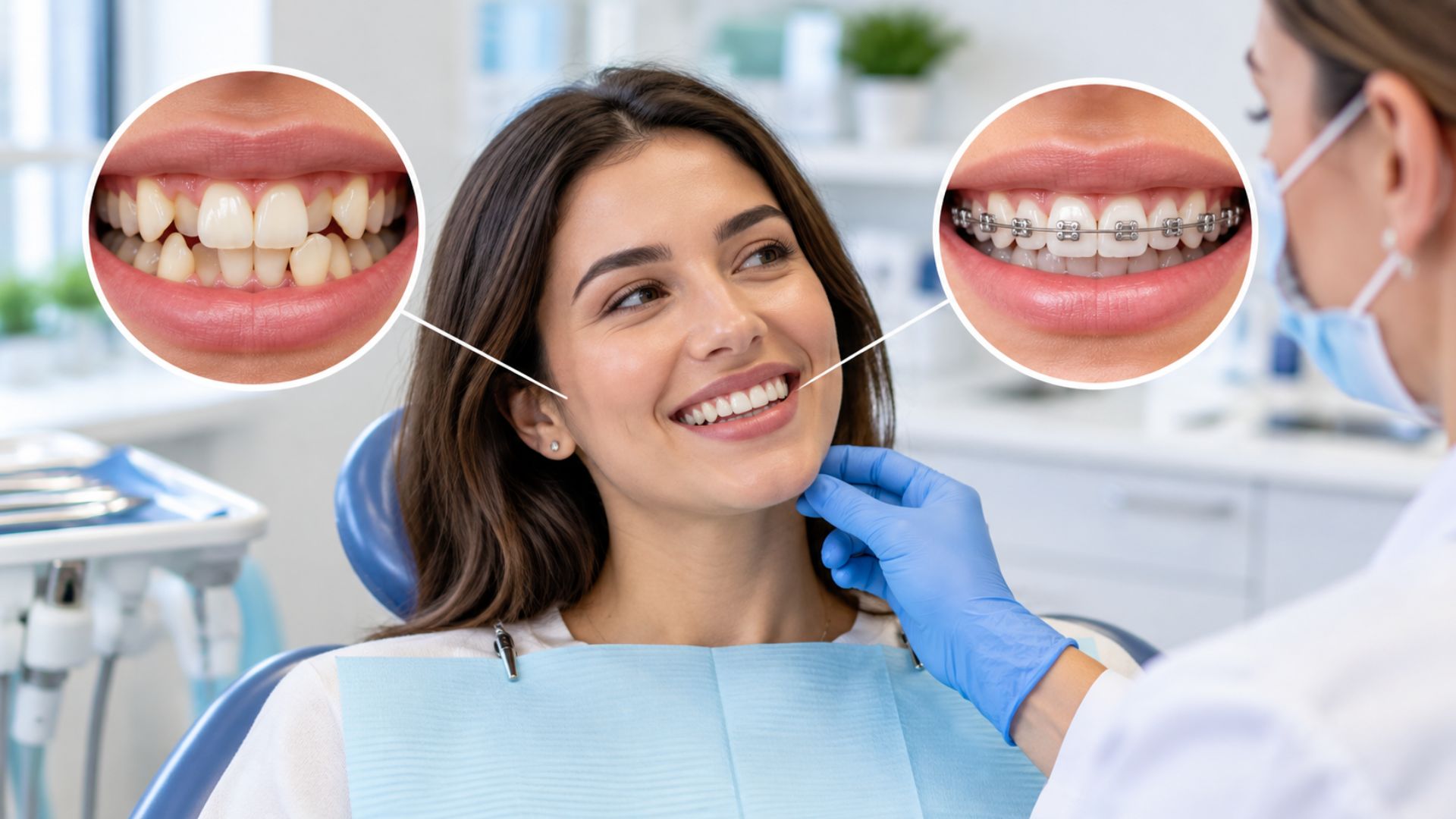

The honest answer is that you probably do not need lingual braces specifically. What you may need is orthodontic treatment, and lingual braces are one of several ways to get it. They are fixed braces bonded to the back of your teeth, on the tongue side, so they straighten your teeth exactly like regular braces while staying completely hidden from the front. People choose them for one main reason: they want the power of fixed braces with none of the visible metal. So the better question is usually not whether you need them, but whether they are the right fit for your case, your appearance concerns, and your budget. For the right person, they are an excellent option, and for others a clear aligner or ordinary braces make more sense.
What makes lingual braces different
Standard braces sit on the front of your teeth, where they show when you talk and smile. Lingual braces flip that. The brackets and wires are attached to the inner surface, so from the outside your teeth look untouched throughout treatment. That is the whole appeal, and it is a genuine one. Unlike removable clear aligners, they are fixed in place and working every hour of every day, and because they are bonded on, there is nothing to lose, forget, or leave out. In many cases they are custom-made to the shape of your teeth, which is part of why they cost more and why they need an orthodontist with specific training to fit them well.
The real reasons people choose them
Beyond the general wish to be discreet, a few specific situations push people toward lingual braces.
The first is a job or role where visible braces feel like a problem. Actors, presenters, singers, models, and people in front of clients or cameras often want their teeth straightened without it being obvious for a year or two. Lingual braces let that happen without a compromise on results.
The second is wanting invisibility when clear aligners will not do the job. Aligners are brilliant for many cases, but very complex movements, significant rotations, or big bite corrections can be beyond what they handle well. Lingual braces offer the strength and control of fixed braces, which can manage tougher cases, while still being hidden. For someone whose case rules out aligners but who cannot face front braces, they can be the ideal middle path. Our overview of orthodontic treatment explains how different appliances suit different problems.
The third is discipline, or the lack of it. Aligners only work if you wear them 20 to 22 hours a day, and not everyone keeps that up. Because lingual braces are fixed, they remove the willpower from the equation entirely. They simply do their job, which suits people who know they would struggle to be strict with removable trays. If your teeth are crowded or protruding, our guide on crowded or protruding front teeth shows the kinds of cases fixed braces handle well.
The trade-offs worth knowing
No option is perfect, and it would not be fair to sell lingual braces as flawless. There are real downsides to weigh.
The biggest is the adjustment period. Because the braces sit against your tongue, your tongue will feel them at first, and it can get sore or irritated for a week or two until it toughens up. Many people also notice a temporary lisp or slight change to some sounds while their tongue learns to move around the braces. This usually settles within a couple of weeks, but it is more noticeable than with front braces, and it matters if speaking clearly is part of your work.
Cleaning is trickier too. The braces are harder to see and reach, so keeping them and your teeth clean takes more effort and care, which is important for avoiding decay during treatment. Lingual braces also tend to cost more than front braces or aligners, partly because they are often custom-made and partly because fitting them is more technically demanding. And not every clinic offers them, since they require particular training, so finding the right practitioner matters, as our guide on choosing an orthodontist in Canberra explains.
How they compare to the other discreet options
If invisibility is your goal, lingual braces are one of three common routes, and it helps to see them side by side. Clear aligners like Invisalign are removable, comfortable, and nearly invisible, but they rely on you wearing them and are best for mild to moderate cases. Ceramic or tooth-coloured braces sit on the front like normal braces but blend in with the tooth, so they are subtle rather than hidden, and usually cost less than lingual. Lingual braces are the only option that is genuinely invisible from the front while still handling complex cases, but they come with the adjustment period and the higher price. There is no single best choice, only the one that fits your teeth, your lifestyle, and your budget, which is exactly what an assessment is for. You can read more about the range of braces available as a starting point.
Frequently asked questions
Do lingual braces work as well as normal braces? Yes. Because they are fixed braces, just bonded to the back of the teeth, they can achieve the same results as front braces, including on complex cases that clear aligners may not manage. The main differences are in comfort, cleaning, and cost, not in how well they straighten teeth.
Will lingual braces affect my speech? They can, temporarily. Because they sit where your tongue rests, many people notice a slight lisp or change to certain sounds for the first week or two while the tongue adjusts. For most people this settles quickly, though it is worth factoring in if clear speech is essential to your work.