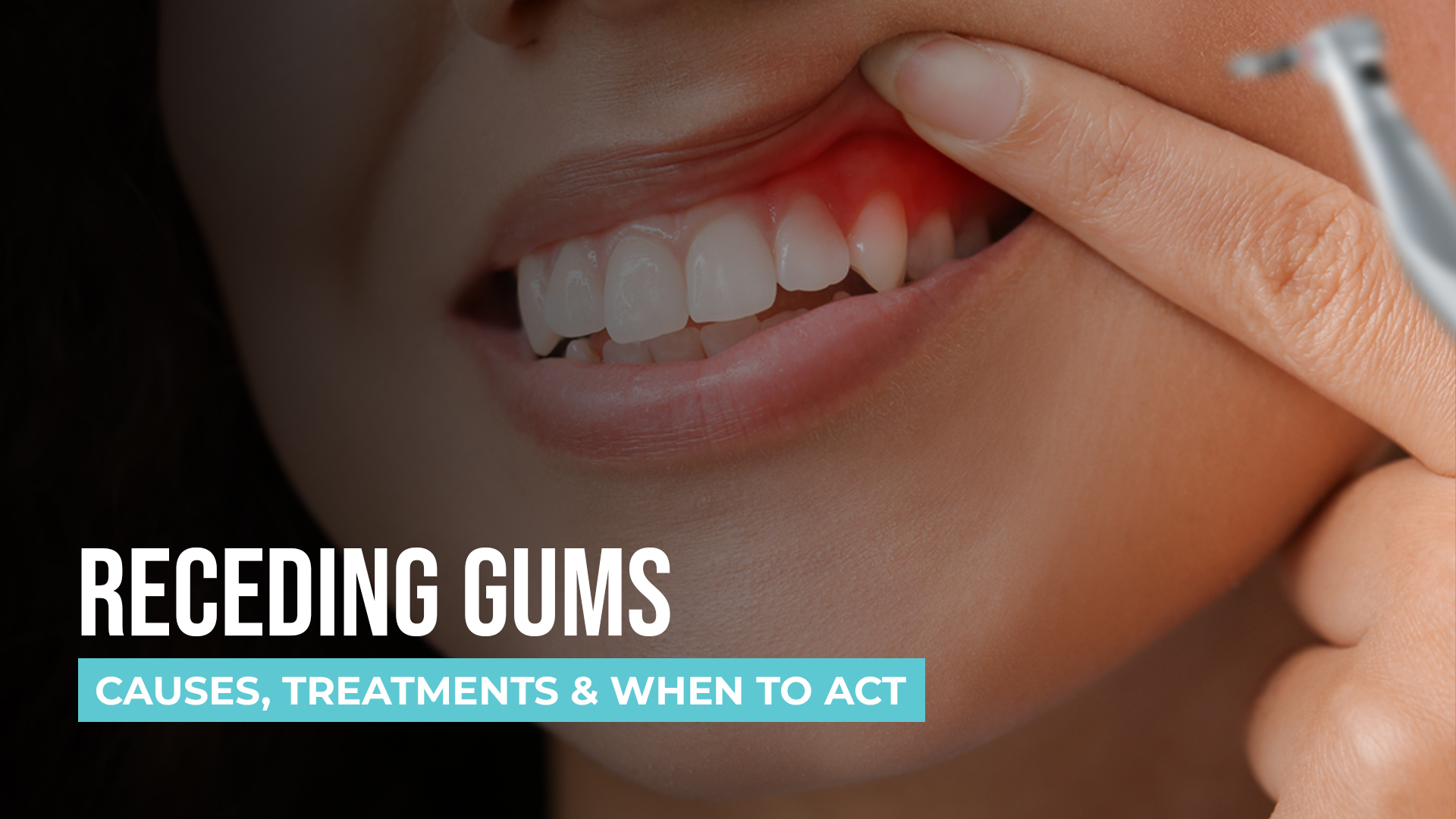
Gum recession is one of those conditions that patients often notice years after it has started. A tooth looks longer than it used to. There is sensitivity to cold that was not there before. A dark line appears at the gumline where the root surface is now exposed. By the time these signs are obvious, the gum tissue that has been lost cannot be recovered without intervention and the process, left alone, continues.
Understanding what actually causes receding gums, what makes some cases progress rapidly and others slowly, and what treatment can and cannot achieve gives patients the context to act at the right time rather than too late. This guide covers all of it.
Key Takeaways
► Gum recession exposes root surfaces that are not covered by enamel, making them vulnerable to decay and sensitivity.
► The two main causes are periodontal disease and mechanical trauma from brushing and they require different management.
► Recession cannot reverse on its own; tissue that has receded stays receded without clinical intervention.
► Early detection allows conservative management. Advanced recession may require gum graft surgery.
► Even aggressive brushers can preserve what remains by switching technique and toothbrush type but what is already lost needs professional assessment.
What Gum Recession Actually Means Clinically
The gum tissue that forms a seal around each tooth is called the gingiva. In a healthy mouth, the gingival margin sits at a consistent level around the tooth typically between the visible crown and the cemento-enamel junction, which is the boundary between the enamel-covered crown and the root. When this tissue migrates apically that is, toward the root tip the root surface becomes exposed.
This matters for three reasons. Root surfaces do not have an enamel coating. They are covered by a much thinner, softer tissue called cementum, which wears more quickly than enamel and is more susceptible to acid erosion and bacterial decay. Exposed roots are also directly innervated, which explains why gum recession so reliably produces sensitivity to cold, sweet, and air. And the loss of gum tissue compromises the biological seal around the tooth, making it easier for bacteria to penetrate deeper and contribute to further attachment loss.
The Two Primary Causes of Receding Gums
Periodontal Disease
Periodontal disease specifically chronic periodontitis is the most common cause of gum recession in adults. It begins as gingivitis: inflammation of the gum tissue in response to bacterial accumulation at the gumline. Gingivitis is reversible with professional cleaning and improved home care. When it is not adequately treated, the inflammation progresses into the supporting structures beneath the gum — the periodontal ligament and the alveolar bone.
As bone is lost, the gum follows. The recession in periodontitis tends to be generalised across multiple teeth rather than localised, and is accompanied by increased pocket depths around the teeth, bleeding on gentle probing, and in more advanced cases, tooth mobility. This type of recession requires treatment of the underlying infection, not simply attention to the gum margin.
Mechanical Trauma [Brushing Too Hard]
The second major cause is entirely different in mechanism and is far more common than most patients expect. Aggressive toothbrushing particularly with a medium or hard-bristled brush, using a scrubbing horizontal motion physically abrades the gum tissue over years. The resulting recession tends to be localised to the outermost teeth where brushing pressure is greatest, is more pronounced on the side of the dominant hand, and is not accompanied by the pocket depths or bone loss seen in periodontal disease.
Patients with this pattern of recession are often meticulous home care practitioners who genuinely believe that brushing harder achieves a better result. It does not. The additional force does not remove more plaque bacterial biofilm is disrupted by the motion of bristles, not the pressure but it does progressively damage the delicate marginal gum tissue over time.
Other Contributing Factors
Thin gum biotype a genetic characteristic where the gum tissue covering the outer surface of the teeth is naturally thin predisposes a patient to recession regardless of cause, because thin tissue tolerates inflammation and trauma less well than thicker tissue. Orthodontic tooth movement outside the boundaries of the alveolar bone can cause recession if teeth are moved too far labially. Mouth piercings in contact with the gum, clenching and grinding, and some systemic medications that cause dry mouth or gingival changes also contribute in specific clinical contexts.
How to Tell If Your Gums Are Receding
Patients most commonly notice recession through increased tooth length the visual appearance of teeth that look 'longer' than they used to. Notching at the gumline can sometimes be felt with the tongue. Temperature sensitivity that is new or worsening, particularly to cold, is a reliable symptom. In more advanced cases, a clear boundary between the whiter crown and the more yellowish root surface becomes visible.
The definitive assessment is clinical. Periodontal probing measures the depth of the gum pocket around each tooth and documents the position of the gum margin relative to a fixed reference point. Serial measurements taken over time reveal whether recession is progressing or stable. This is part of the clinical assessment at every check-up at Kaleen Family Dental.
How Receding Gums Are Treated
Addressing the Cause First
Treatment always begins by identifying and managing the underlying cause. For recession driven by periodontal disease, professional scaling and root planing removes bacterial deposits from below the gumline, eliminates the source of inflammation, and creates conditions in which the remaining attachment can stabilise. This is performed under local anaesthetic and may require multiple appointments depending on severity.
For recession caused by aggressive brushing, the intervention is technique modification and toothbrush change. Switching to a soft-bristled brush and adopting a gentle circular or modified Bass technique removes biofilm just as effectively and eliminates the mechanical trauma to the gum margin. An electric toothbrush with a pressure sensor is often recommended because it removes the variable of applied force entirely.
When Gum Graft Surgery Is Indicated
Once the cause is managed and recession is stable, the question becomes whether surgical correction of the recession site is warranted. Gum graft surgery most commonly a connective tissue graft involves taking a small amount of tissue from the roof of the mouth and placing it over the exposed root surface at the recession site. When successful, it covers the exposed root, reduces sensitivity, and provides a thicker, more resistant tissue profile that is less vulnerable to future recession.
The indication for grafting depends on the degree of recession, the patient's symptoms, whether the recession is progressing despite cause management, and aesthetic concerns. Not all recession requires grafting well-managed, stable, mild recession in a patient with no symptoms may be appropriately monitored rather than surgically treated. This is a nuanced clinical decision, and one we make collaboratively with patients at Kaleen Family Dental.
Frequently Asked Questions
Can receding gums grow back without treatment?
Gum tissue that has receded does not regenerate spontaneously. The body does not re-grow lost gum tissue through improved brushing or any home remedy. What can be achieved without professional intervention is stabilisation stopping further recession by removing its cause. Recovery of lost tissue requires clinical treatment, either through management of periodontal disease and observation of limited regrowth, or through gum graft surgery where recession is significant.
What is the fastest way to stop gum recession?
The fastest way to prevent further recession is to identify and eliminate the cause. If aggressive brushing is responsible, switching to a soft-bristled brush and modifying technique produces an immediate change in the mechanical environment. If periodontal disease is the driver, professional treatment to eliminate the infection removes the source of ongoing tissue destruction. Neither is a quick fix but both are highly effective when followed consistently.
Does gum recession treatment hurt?
Periodontal scaling and root planing is performed under local anaesthetic and is well tolerated. Gum graft surgery involves two wound sites the donor site at the palate and the recipient site at the recession — and the first one to two weeks of recovery involve some discomfort at the palate that is managed with prescribed pain relief. Most patients find the recovery more manageable than they anticipated.
Is gum recession covered by health insurance?
Periodontal treatment is generally covered under major dental extras in most private health funds, subject to annual limits and waiting periods. Gum graft surgery may attract a rebate under major dental, though the specifics depend on your fund and policy. We process claims via HICAPS on the day so you know your out-of-pocket cost before you commit to treatment.
Gum recession that is caught early is managed conservatively. Recession that is left to progress becomes progressively more difficult and expensive to treat. If you have noticed your gums appear to be pulling back, or you are experiencing new sensitivity at the gumline, book an assessment at Kaleen Family Dental Surgery. Call (02) 6241 5941 or book online we are here Monday to Saturday.